Part 1: Disney and the Downfall of John Lasseter
How did we get here? As a Disney fan for over 50 years, I was a die-hard fanboy of the company, to the point that Film Threat readers referred to me as a Disney shill. I used to spend thousands of dollars each year throughout the parks, buying merch, and watching every film the Walt Disney Company produced. But something changed, and the so-called Disney magic began to fade. Today, thousands of dollars have turned into a scant tens of dollars. I haven’t visited a park since the “dark times,” and my excitement for anything Disney has turned to disdain…so again, what happened?
Our story begins with a single event not so long ago that fundamentally changed the company culturally and creatively. Mind you, this single event is not the reason for the fall of Disney; as we’ll show, those seeds had been planted long ago during the Eisner era. This event served as the catalyst for the inevitable creative and financial collapse of the company that Walt Disney started 100 years ago. As Elon Musk surmised, “Walt Disney is spinning in his grave like a drill bit.”
That single event was the removal of Disney’s Chief Creative Officer, John Lasseter. This story of Lasseter’s demise will be told from the perspective of the rank-and-file employees at Disney and Pixar, revealing what they observed and how they felt when it happened.
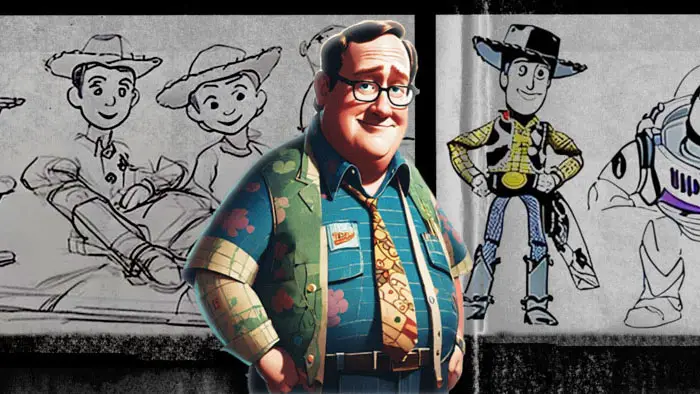
“This story of Lasseter’s demise will be told from the perspective of the rank-and-file employees at Disney…”
Any Disney fan knows the impact of Lasseter’s creative influence on the company. Along with founder Steve Jobs, Lasseter’s groundbreaking work at Pixar gave birth to the computer-generated animated feature industry as we know it today. After the release of Toy Story, he was thrust into the public eye as the bright future of Disney. Through his guidance at Pixar, innovations in animation quickly eclipsed the legacy set by the initial Disney savior and CEO, Michael Eisner. Dare I say, John Lasseter was poised to become the next Walt Disney as the creative demigod and public face of the company.
Eventually, in 2004, news of Pixar’s impending divorce from the Walt Disney Company made headlines and panicked Disney fans. Eisner’s magic touch on the company was waning, and Walt’s nephew Roy would engage in a hostile attempt to reclaim the company, resulting in installing Bob Iger as the new CEO.
In 2006, one of Iger’s first steps was the $7.4 billion purchase of Pixar, making John Lasseter Disney’s Chief Creative Officer. The merger put Lasseter in charge of overseeing multiple aspects of the company—primarily Pixar and Disney Animation.
Who is John Lasseter, the man? Our sources described him as two different people. In speaking to current and former Disney/Pixar Animation employees, support staff, and outside independent contractors, the consensus was that Lasseter was a joy to work with. Disney fans saw him as a father figure. He worked hard to create an environment where everyone felt like family and looked forward to coming to work each day. Other sources, who hoped to one day become artists and animators, once believed that working at Pixar was the ultimate dream…and for many, were excited to one day work for John Lasseter.
But like a father, John Lasseter was a perfectionist. His insistence on absolute perfection was notorious for everyone who worked for him…meaning EVERYONE. I was told numerous stories of his almost stone-cold criticisms of their creative choices. When presenting one’s ideas to Lasseter, all emotion would drain from his body, and he would matter-of-factly tell you why your idea sucked and then tell you how to make it better. Many who understood John Lasseter saw this as a stinging learning opportunity, yet this tough love was applied equally to all.
Not everyone saw it that way. One source recounted observing a prominent figure at Pixar who had their idea derided by Lasseter and took it as a personal attack on not just their ideas but also on them. It was apparent that to this observer, this fatherly persona of the warm and loving Lasseter was instantly dashed.
“…described him as two different people.”
What many considered Lasseter’s most significant attributes soon turned into a weapon against him. From a management standpoint, his insistence on perfection meant that most creative decisions about a project had to be run by him. This single point of approval created a bottleneck in Disney Animation and Pixar. Projects were delayed because people were waiting for Lasseter’s approval. This problem reached a boiling point among Disney Executives with the failure of The Good Dinosaur. Maybe John is biting off more than he can chew.
Then there’s the corporate ego. Maybe some within the company considered Lasseter could become a threat to his superiors…like Bob Iger. From a fan’s perspective, John Lasseter seemed to be the heir apparent to Walt Disney himself. He had an upbeat and positive demeanor on television. His collection of Hawaiian shirts garnered “Oh, Dad!” from fans. What would happen if Lasseter did ultimately step in the literal shoes of Walt Disney? Is it possible that Disney Executives saw this as a threat? Just speculating, but was Lasseter due to be taken down a peg or two…or maybe entirely off the board?
One perceived problem Lasseter had was his penchant for hugging. Hugging and other forms of familial affection seem harmless, right? Many sources saw this as a positive trait but knew it was potentially problematic. They noted that many employees and Cast Members looked forward to a Lassiter hug and viewed it as platonic affection. While others didn’t, and rightfully so. Let’s be clear: not wanting a hug is perfectly acceptable, and personal boundaries must be respected, especially in an office environment, no matter if they are perceived as harmless. Some felt that he might take offense, whether warranted or not, and their hug refusal could affect their professional growth in the company. Important: our sources felt that this issue of personal boundaries was a significant problem and should have been addressed years ago.
It was also no secret that Lasseter liked to drink, particularly at office functions and celebrations. No one said he had a drinking problem, but alcohol did present problems for Lasseter in public settings. Film Threat Publisher Chris Gore recounts working with Lasseter at the Sonoma International Film Festival. The parties were lavish, the wine flowed freely, and Lasseter loved wine. Several sources confirmed that alcohol was becoming a problem to the point that Disney corporate was forced to have handlers on stand-by to watch over Lasseter to avoid the mere appearance of impropriety.
In October 2017, the New York Times and The New Yorker broke the news of decades of alleged sexual misconduct by prolific movie producer/mogul Harvey Weinstein. The revelation and eventual conviction of Weinstein’s crimes led to a global wave of similar allegations against prominent figures in Hollywood, known as The Weinstein Effect. While the #MeToo movement rightfully exposed many sexual predators in Hollywood, several people believe the movement was used as a political and corporate weapon against specific figures. Some questioned whether targets were actual predators or political or corporate scapegoats and how it was easier to prosecute them in public rather than in a courtroom.
Like lighting in a bottle, Lasseter fell victim to The Weinstein Effect. Reports of his inappropriate behavior made their way to the public and the board. According to the Hollywood Reporter’s Kim Masters, a longtime Pixar employee said that Lasseter was known for “grabbing, kissing, and making comments about physical attributes.” As these accusations circulated Disney, our sources questioned how these stories were framed as malicious and possibly unfair accusations against Lasseter.
Like a wildfire, these rumors and innuendo spread quickly, causing many to question and consider their most recent interactions with Lasseter. For example, Masters reports that he “made an unwanted advance” toward Toy Story 4 writer Rashida Jones. Though Masters immediately quotes Jones as refuting the claim, “We did not leave Pixar because of unwanted advances. That is untrue,” the damage was done. Now, false rumors are being planted in the minds of his detractors. It didn’t stop there. Anonymous reports of Lasseter’s behavior continued to run in the mainstream press. According to Variety, Lasseter’s exploits bloomed, stating he had a reputation for touching women inappropriately, including rubbing their legs and kissing them on the lips. Lasseter was also reprimanded for making out with a subordinate at an Oscar party in 2010.
“Like lighting in a bottle, Lasseter fell victim to The Weinstein Effect.”
Confusion and potential ulterior motives swirled amongst many of Lasseter’s loyalists. Was a friendly hug from Lasseter merely a hug? Was a kiss on the cheek or the lips more than a kiss on the cheek or lips? Were compliments about one’s appearance more than compliments? With the fires of the #MeToo movement raging, many within the rank-and-file knew Lasseter’s days were numbered, and his supporters were helpless…or more afraid to defend him. We’re told that anyone willing to defend Lasseter or even ask a question was silenced out of fear.
In November 2017, it was announced that John Lasseter would take a leave of absence from Pixar and the Walt Disney Company. Sources felt that this allowed Lasseter’s detractors to bring allegations against him without real opportunities to defend himself. Though we have no details regarding what happened to John during this time, other high-profile Disney firings included lengthy “struggle sessions” and high-pressure sensitivity training that I will highlight in future reports. If his case were resolved like other harassment firings at that time, Lasseter would most likely be forced to sign an iron-clad NDA, preventing him from ever defending himself in public.
It became apparent within the walls of Disney that anyone supporting Lasseter must immediately go into protection mode by keeping their questions and opinions to themselves. The office culture at the House of Mouse changed drastically overnight. Sources observed that the mood was grim, going from bad to worse. The warm family environment would never return. Regarding Lasseter’s innocence or guilt, our sources did not outright believe or not believe the accusation against Lasseter, but they had questions. Questions that they knew would never be answered. Alternately, many felt that an activist faction within the company was growing and conspiring to remove Lasseter, and his inappropriate behavior was the perfect weapon to use against him. Now, it was a matter of how to frame these stories for maximum effect.
So now it appeared the pieces were in place with certain executives wanting to oust Lasseter and a growing faction within the rank-and-file pressing forward with a stack of allegations against him that to this day goes unprosecuted and unproven. With pressure from the top and bottom, in June 2018, Lasseter announced that he would leave the company at the end of the year. One source told us that during an all-hands meeting, once the announcement was made, a female employee raised her hand and asked, “Can we have a woman run this place now?”
This source mentioned that Disney had plenty of qualified women in positions of authority. Yet, it was repugnant how they planned to replace a single man, John Lasseter, who arguably made billions for the company, with someone solely on the qualification that that person was female, rather than find someone (female or male) who had the passion, experience, and talent to take the company where it needed to go creatively. Common sense would tell you that your experience matters more in business than your appearance.
Sadly, Lasseter’s firing wasn’t exactly a surprise. Many also knew that it didn’t take a rocket scientist to know that once major players in Hollywood started going down, these “forces” would inevitably go after Lasseter. Yet, it’s worthy of note that despite his shortcomings and behavior (whether seen as affectionate or inappropriate), John Lasseter was generally loved and respected by most people he encountered professionally, and that Lasseter’s behavior could have been corrected long ago. They questioned why Lasseter’s behavior was never addressed years before #MeToo. His behavior could have been corrected long before #MeToo and been an example to all management and staff regarding appropriate behavior in the workplace.
“Are Hawaiian shirts even allowed to be worn on campus anymore?”
The message was clear — John Lasseter left the Walt Disney Company an utter and total disgrace. Disney Legend…forget it. In fact, moves have been made within the halls of Disney to remove his legacy as if he never existed. Anything that reminded the rank-and-file of Lasseter was removed from plain sight. Are Hawaiian shirts even allowed to be worn on campus anymore? Or heaven forbid, you should utter the phrase, “When John was here…” Publicly, it’s not much better. I recently mentioned John’s name to a Disney-fanatic friend, and their instant retort was, “he’s a bad man.”
The worst part of the entire experience was the leadership vacuum created by John’s absence. Our sources describe life at Disney afterward as hostile—to say the least—and this hostility spread to all of Disney’s business units and brands. Cast Members felt like they were constantly walking on eggshells. The mere act of casting doubt or asking questions about the allegations was met with hostility. You became a marked person, subjected to mind-numbing HR meetings and forced sensitivity training. It gets worse.
Arguably, Lasseter’s departure also marked the start of the steady creative decline of the Walt Disney Company. The last film he directly influenced was Pixar’s Coco in 2017. Many of us fans believe that Coco is Pixar’s crowning achievement in its prolific catalog. By the company’s own admission, the creative cracks started to appear in its next feature, Cars 3, as they began applying gender-based statistical analytics to story development, e.g., counting lines of dialogue — more on this to come.
Though he was never officially charged with formal harassment claims or indictment, and we have very little evidence one way or the other, our sources point to the talent who eventually defected from Disney and followed Lasseter to Skydance Animation as an indicator of the veracity of allegations laid against him.
In the following weeks, a series of stories on Film Threat will detail the current state of working at Disney. Through the eyes of current and former Disney employees, I’ll show how the seeds of the current corporate culture were planted long ago and how this hostile and very political environment has driven out Disney’s creative, talented, and veterans, resulting in the steady decline of quality across the entire brand. As other outlets cover the current corporate and legal battles at Disney today, I will show the events that led up to the impending financial implosion of the Walt Disney Company.
Part 2: The Great Mouse Reset
As exposed in part one of The D-Files, the removal of John Lasseter was never about removing a “bad man,” but more that his personal demons were used as an excuse/weapon to remove him from creative power at the Walt Disney Company. The next step should have been replacing Lasseter with someone equally talented as him. Instead, the sinister forces within Disney saw his firing as a chance to initiate “Disney’s Great Reset.”
If there was ever a time to radically change Disney from the inside, that time was now. With Lasseter out of the way, he was replaced at Disney Animation by Jennifer Lee and Pete Docter at Pixar. Lee was the writer and co-director of the smash-hit Frozen, and Docter had been a creative force at Pixar for years, directing Up, Inside Out, and Monsters, Inc. At the outset, the choices appeared solid. Still, in the case of Disney Animation, radical changes needed to be made in the racial and gender makeup of its leadership and creative process. This change began with Raya and the Last Dragon.
“…gunning for Briggs and Wellins by foisting impossible tasks on them to either get them fired or, better yet, force them to quit.”
It was October 2018, and Lasseter’s last Disney film, Raya and the Last Dragon, was still in the early stages of development and storyboarding. His fingerprints were all over this project. The initial directors were Paul Briggs and Dean Wellins, with Adele Lim (coming off her success with Crazy Rich Asians) as the sole writer. Unfortunately, this trio was seen as being “Lasseter people.”
Briggs and Wellins needed to go as they didn’t fit the correct demographic (or maybe they were Lasseter loyalists) to tell Raya’s story properly. Rumor has it that Lee was gunning for Briggs and Wellins by foisting impossible tasks on them to either get them fired or, better yet, force them to quit. Being the veteran talent that they were, the traps didn’t work. Briggs was demoted to “co-director,” and Wellins was given a Disney+ series to direct.
Disney did have a diversity problem within animation, prompting Jennifer Lee to recruit new talent from the outside. Lee brought in Carlos López Estrada to direct. The Mexican-American (not Southeast Asian) director was coming off his DGA nomination for his first feature, Blindspotting. Before that, Estrada was an experimental theater director who worked his way into directing music videos and commercials.
Estrada was the emerging director needed to bring a fresh perspective to Disney Animation. The problem is that directing animation is different from directing live-action features. His inexperience quickly showed, and veteran director Don Hall was brought in to give the fresh face on-the-job training. Raya and the Last Dragon was Estrada’s first and last Disney project, as he would return to directing music videos.
The other curious move by Jennifer Lee had to do with writer Adele Lim. I’m just speculating here, but was Lim now being targeted by Lee because she was a Lasseter hire? What was the reason for bringing in a second writer? Lim was now forced to share writer credit with Lee’s new recruit, Qui Nguyen, whose credits to this point were a handful of television episodes as a writer, but mostly staff writer credits.
The addition of Nguyen begs the question, why would Lim, coming off a $239 million success with Crazy Rich Asians, need to share a writing credit (and paycheck) with a relatively inexperienced television writer? In my humble opinion, Disney decided to take a talented and studio-proven Asian woman and reduce her to a mere “diversity hire.” After Raya and the Last Dragon, Lim left Disney to write and direct her feature films, including Joy Ride (2023). Her co-writer Qui Nguyen would go on to write and co-direct the 2022 Disney flop Strange World.
From here, Raya and the Last Dragon turned from being a traditional Disney animated production to slowly transforming into Disney’s first DEI test case. Step one was to load the entire project with female South Asian animators and talent from within the company, then female Asian animators, then female POC animators, and the rest. But that wasn’t enough. Rather than pull in other artists from within, a major recruitment push was made to hire more women from outside the company to reach a 50/50 male/female balance for equity’s sake.
“…not enough as an animator to be a talented female person of color; you have to be ‘WiA-Approved’ and toe the line.”
A concerted effort was made to think “outside the box” when recruiting at Disney. During The Female Lead‘s Filmmaker Panel for Raya and the Last Dragon, head of story Fawn Veerasunthorn stated that Disney had decided to change the landscape of its hiring pool, which was once art school graduates, from such stalwart institutions as CalArts. She states that new talent emerged from millennials like herself on social media. In her own words, “Traditionally, where [Disney] would go to really expensive colleges where not everyone may be able to afford that. Now, that doesn’t have to be the case anymore. You know, maybe the company can look at how they can hire outside of their usual norm or hire internationally.”
Disney Animation did go out of its norm in hiring with the help of Women in Animation (WiA), an advocacy group created in 1993. Their mission states, “We envision a world in which people of all gender identities share fully in the creation, production, and rewards of animation…” With Raya and the Last Dragon, that aggressive push for Gender Equity and to radically transform an industry starts NOW!
Sources tell us that with Raya and the Last Dragon, the goal wasn’t to bring diversity, equity, and inclusion into the existing community of Disney animators but to replace it with a radicalized group of female activists completely. One female POC animator contacted us about her experience with WiA to further her career in animation. She was looking for mentorship and resources to break into the industry. While initial discussions were cordial, she was quickly ghosted by the organization because she did not live in Los Angeles and could not be helpful to their cause.
Our source also told us that once she expressed concerns about the mission of WiA, she found herself blacklisted from the industry (a prevalent story we’ve heard) and felt that WiA and similar organizations had become the gatekeepers for women to enter animation. It’s not enough as an animator to be a talented female person of color; you have to be “WiA-Approved” and toe the line.
Another example of this new activist culture is the formation of a segregated women’s committee that meets regularly to pitch ideas, network, vent, look at storyroom strategies, listen to guest speakers, and empower each other to take on leadership roles. Many of these sessions are sponsored by WiA and strictly for “female-identifying and non-binary people.” Can you imagine going into a creative meeting knowing that half the room has already made all the decisions beforehand? These meetings are literal war rooms as so-called creative sessions are now considered battlefields. Now, imagine if you disagreed with one of their ideas. Shots fired! I’m sure there’s a large bag of “ists” nearby to hurl your way.
People of Talent
Truth be told, Raya and the Last Dragon was a success (considering it came out during the pandemic), garnering positive reviews and Best Animated Feature nominations during award season. Its success likely happened because there was still a presence of veteran talent who found a way to make the work of inexperienced talent look good. You’ll soon see that as veteran talent began to move on to new and better opportunities and enjoyable work environments, the quality of Disney animation would begin a slow yet steady descent downward with Wish, which quite frankly was the impetus for this series.
“…a dominant, overpowering voice that insists on having its way, resorting to aggressive and bullying tactics to stifle any form of dissent or critique.”
How did we get here? The industry of animation and art is broad, and the idea of 50/50 equity between men and women is both admirable and achievable. The problem is that culturally, the animation industry has been dominated by men since its inception over a century ago. The truth is that firing or demoting half your male staff and replacing them with their inexperienced counterpart will drastically affect creativity and quality.
More importantly, diversity and equality should be the end-game goal in animation, as with any American industry. Incorporating a wide range of underrepresented voices is necessary to foster a diverse spectrum of perspectives. The problem is that those leading this DEI movement foster a dominant, overpowering voice that insists on having its way, resorting to aggressive and bullying tactics to stifle any form of dissent or critique. This approach undermines the very definition and essence of diversity, turning what should be a rich, multifaceted dialogue into a one-sided bully pulpit that silences valuable contributions.
The mission of DEI is not equality…it’s revenge. The final outcome is a complete takeover…a reset…of the entertainment industry as a whole.
Conclusion
In the next D-Files, I will show how Disney Animation has become a toxic environment, where Cast Members are constantly walking on eggshells in fear of HR, and how creativity and technical excellence have been slowly dying over the years. What would Walt think? In the words of a high-level Disney executive, “F**k Walt!”
Part 3: Disney the Killer of Dreams
Like every member of the Disneyana family, Walt Disney has always been a part of our lives. The first movie I ever saw was Mary Poppins. There was nothing more exciting than our annual trip to Disneyland. I watched anything and everything Disney. I’m old enough to have watched re-runs of The Wonderful World of Disney, hosted by the man himself, Walt Disney. Hell, I’ve spent tens of thousands of dollars on the company. You’re welcome.
For me and many others, working for Disney and being a part of Walt’s grand legacy was the dream. My first post-college interview was with Disney Studios (didn’t get it). Living in Orange County, I know more people who worked for Disney than those who didn’t. What was a dream decades ago has now become a nightmare. Though the change in the wrong direction happened long before Bob Iger fired John Lasseter, it was at that moment the corporate and office culture at Disney made a turn for the worse and became a toxic environment where the inmates ran the asylum.
Killer of Dreams
In the last D-Files, I showed how outside sinister forces got their foot in the door at Walt Disney Animation, beginning with Raya and the Last Dragon and under the banner of #MeToo and gender equity. Rather than naturally developing female and minority talent, Disney, under the leadership of Jennifer Lee, chose to force 50/50 equity at the studio, like Mickey Mouse cleaning up the Yensid’s laboratory in Fantasia.

“The result of this ‘wish’ may have destroyed the animation industry in America in one fell swoop.”
The result of Lee’s “wish” may have destroyed the animation industry in America in one fell swoop. The unintended (or some would say intended) consequences of her actions were the creation of a toxic work environment where everyone is walking on eggshells and intent on shoving out veteran talent and ushering in an army of activists dead set on transforming the company in a way that Walt Disney himself would not recognize.
New Tainted Blood
Previously, I touched on the nature of the new blood brought into Disney Animation, like Maleficent’s Goons. Since that article, new information has come to light that will illuminate who these new artists are and where they came from. I referenced The Female Lead’s filmmaker panel from Raya and the Last Dragon, particularly a statement from Head of Story Fawn Veerasunthorn regarding the hiring pool.
When she addresses how she got her job at Disney, she states, “I didn’t grow up in the big city, and I think with the change of internet and social medias [sic], I think the youngest generation will benefit from being able to see the work that millennials, like me, put out there on social media platforms and for us to be able to see a variety of talents [sic] who’s putting their work out there. That kind of changed the landscape of the hiring pool.”
Instead of hiring formally trained artists from traditional institutions like Cal-Arts, Disney (with the help of Women in Animation) explicitly recruited from social media sites, including Tumblr and Reddit—a fact confirmed by numerous sources.
To be clear, Tumblr was not inherently problematic. Most of my contacts used Tumblr to host their portfolios and included links to the site on their CV. What mattered was that your social media profile checked the right boxes (i.e., “female” and “not White”). Today, that box has revised to “female-presenting.”
One source said as long as gender quotients in hiring were being met, “it didn’t matter what your experience was, as long as your ‘stuff looked good’ you can work for Disney Animation…and any animation studios—Paramount, Dreamworks, Netflix, Warner Bros, etc.”
Another source noted that Tumblr was “UNEQUIVOCALLY” the base for new talent. Women from the social media site were quickly scooped up and placed on Raya and the Last Dragon, along with other animated shows and features. Talent is now an afterthought. It was more important that these women could pad the quotas and become useful foot soldiers for the cause of DEI. Once in, the activists were asked for referrals, and now they were in a position to hire other artists from their “friend squads.” They were now hiring based seemingly on their politics; these “friend squads” quickly created a powerful contingent not just at Disney.
The existence of these “squads” began to radically shift the power structure at Disney Animation, which led to radical changes in the long-held Disney traditions of animation (more on this in the D-Files, Part 4).
Let’s talk about quality. The vast majority of the newly hired Tumblr talent is self-taught. There’s nothing wrong with that as an artistic starting point. Successfully copying your favorite artists is the first indicator that one has minimal talent. The problem is that Tumblr is not art college and will not give you the proper training required to grow. Tumblr-based artists are constantly being affirmed by fellow Tumblr artists…which breeds an unhealthy level of narcissism and bad habits. Constructive criticism is the key to growth, but online criticism of one’s art is often taken personally and inevitably sparks drawn-out struggle sessions of hurt feelings followed by personal attacks. Best to keep your criticisms to yourself if you want to be part of the “friend squad.”
It is well-known in the art community Tumblr has a bad reputation. In fact, “Tumblr cartoons” is a term for awful animation featuring bad design and uninspired storytelling. One source told me, “Tumblr was Ground Zero for this mess we’re in. Along with a sub-par portfolio, these artists had not yet completed their ‘ten thousand hours,’ and they brought bad art habits with them into the big animation studios.” Some artists also find Tumblr cartoons too preachy or heavy-handed, sacrificing subtlety and nuance to align with “The Message.”
Social media isn’t exactly the breeding ground for building a healthy community and interpersonal interactions. Tumblr communities foster an echo chamber effect where certain ideas or ideologies are reinforced without much critical discussion or diversity of thought. Relevant here is a new form of woke storytelling where villains are no longer needed, or female protagonists don’t need no man to save them. Can someone remind me what the definition of “incel” is? Tumblr became the perfect breeding ground for activists perfect for Disney’s new “reimagined” storytelling.
These recruits had a very specific personality. In them, Disney found their value as influencers, not artists. As one source puts it, “[Disney] was more than ready to hire influencers than a more reserved person with actual talent. Influencers have the potential to bring in their fan base to ‘replace’ whatever old fan base was there before. Unfortunately, Disney gave these influencers too much credit to do exactly that.” In other words, Disney overestimated their artistic talent and underestimated their ability to attract an audience.
“The goal was to clear out as many ‘Old White Guys’ as possible at Disney Animation…”
When the new animators entered the hallowed halls of Disney animation, the veteran staff instantly knew trouble was brewing. The first warning sign was the quality of their work or lack thereof. Who’s Walt Disney? Walt Disney himself inspired the work of these veterans; they studied Walt’s classic features and shorts, and that’s how they got their jobs at Disney. Not true with these recruits. They understood very little about actual animation and bringing art to life. My source said that their influences were not from Walt but from whatever was currently popular with Gen Z and Millenials at the time, which in this case was anime…a very different art form and style. When asked about the classics like Snow White, Dumbo, and The Jungle Book, their response was blank stares.
When these recruits started doing their highly coveted jobs, they struggled to succeed at a job they weren’t qualified to have in the first place. Attempts to offer help or mentoring from the “Old White Guys” were met with an undeniable cold shoulder. One veteran animator described the new hires as having “open disdain for the ‘Old White Guys.’” Comments veterans made during creative meetings were met with snarky replies by the youngsters. In a moment of entitlement, one young female POC said after a notes session, “They won’t listen to MY ideas.”
The turnover at Disney Animation was high among these recruits…and among the veterans as well. Many who realized they were not qualified to animate left feeling dejected…a dream killed. Others had very little passion for animation and didn’t like the work they were given. Instead, they demanded to be promoted to other positions, which was granted. Sources say that they were moved away from art to story. The foundation Walt built for animation was quickly beginning to crack.
During one creative meeting, there was a discussion of why people were leaving the studio in droves. Regretfully, one artist said, “We’re getting tired of being disrespected,” and the response was met with ‘Yeah, but YOU don’t know what it’s like to be a woman!’” The actual details of this interaction are much more disturbing.
Bye, Bye, Old White Guy
Disney could not reach 50/50 male/female equity without clearing out the “Old White Guys.” They needed to go, and outright firing them was not an option. The tactic was simple: first, exasperate, and then attack.
It started with “demotions” for the “Old White Guys” in an attempt to demoralize them. The targets were given mundane and inconsequential scenes to work on, regardless of their vast experience…scraps for the dogs. Second, if they questioned or complained about their assignment, they were given impossible scenes to work on in an impossible amount of time. When the work was turned in, the new emboldened recruits harshly criticized their work to the point of humiliation. The goal was to make life so miserable that they’d quit or be forced to fall in line with the new normal. If that didn’t work, something worse was waiting in the wings.
The once-happy Disney family created over the decades was quickly torn apart. One YouTube commenter said, “male animators are hesitant to work with or around women in fear of being canceled, fired.” The passive-aggressive messages began to sink in…they were no longer wanted. Many veterans chose to leave for the sake of their mental health and self-respect. Others were forced to endure the abuse for financial reasons and simply sit quietly and mind their business.
Toxic Work Environment
Sadly, the tactics worked. The effort to remove or control the “Old White Guys” was effective, and the activists began to “hunker down.” As the young Millennial and Gen Z artist-activists began filling quickly vacated positions, their behavior was emboldened. These recruits had an advocate in Women in Animation (WiA). At this point, WiA was becoming a powerful player in animation. Their leadership was filling prominent executive positions at ALL the major studios as well as within the Animation Guild (the animators’ union).
Being the resource that they were, the female recruits had access to lectures on gender/social issues on the WiA website. These lectures included how to handle situations where you feel uncomfortable at a studio, discussions on how to be “heard” at staff meetings, “seen” at creative meetings, and how to “rise” through the ranks of leadership quickly. Everything you need to have a “successful” career was there without mentioning “animation” entering the conversation. Ironic as the “A” in WiA stands for “animation.”
“These new hires were recruited as activists and trained to be ‘bullies.’”
The toxicity of the Tumblr and Reddit forums now invaded all corners of Disney Animation. These new activist recruits were being groomed to be office “bullies.” They were actively encouraged to expose inappropriate office culture behavior and report it to HR. They were proactively looking for men and non-compliant females to complain about, all under the guise of “making a more healthy working environment.” Spies were everywhere in the office, and you didn’t know who was listening to your conversation or where they were lurking. Question. Wasn’t there a time not so long ago when citizens were asked to spy and report on their “problematic” neighbors? Keep your answer to yourself, and for God’s sake, don’t tweet about it.
Soon, there was an effort to root out the infidels. All meetings opened with the gentle encouragement that “this is a safe space.” It meant everyone was free to talk over any issues and be heard. In the immortal words of Admiral Ackbar, “It’s a trap!!!” One source told me that no one over 40 would say anything to avoid heat from the “crybabies” existing in this safe space, which then turned into a public lecture or reprimand about racism or misogyny. If your “crime” was especially horrible (or perceived that way), you were forced to take sensitivity punishments courses to keep your job and become an ally.
Question: What is the difference between an adult and a child? Adults have thick skin and let criticism fall off their backs. Children fall apart and run to mommy (HR) to take care of the bad man. The problem was that this “tattletale” behavior was encouraged by senior management. All it would take was someone in power to tell these kids to grow up, and this behavior would end. Yet, the calvary never came.
White male artists were constantly being brought into HR for the most minor infractions on race, gender, or sexual orientation. Most of the complaints were described as ridiculous and dumb. NOTE: When asked for specific examples, all of my sources said that the details of their “crimes” were so specific they would reveal their identities and jeopardize their current jobs. Believe me, I asked many times, which leads us to the “Animation Blacklist.”
Animation Blacklist
“Yes, Donald. There is an animation blacklist,” and one Disney artist finds himself on it and has not worked to this day. I have changed many of the “alleged” details regarding this incident to protect my sources.
As the activists began infiltrating the ranks of Disney Animation. One artist complained about how fast things were changing and openly questioned the direction “woke” storytelling was taking the particular project he was working on. The questions were not taken well, and this artist was placed on the s**t list. When he wondered why a newly hired “less-talented” female POC artist was getting the work that he used to get, he had to endure comments about the patriarchy, “knowing his place,” and his earnest pleas were met with severe repercussions.
With a decade of quality work done for Disney, his work was now being nitpicked to death with a fine tooth comb, criticized more harshly than his female counterparts, and all in an attempt to break his spirit. He described his treatment as “demoralizing and intensely passive-aggressive.” This artist kept his head down, shut his mouth, and continued to do his job to the best of his ability.
On one ominous day, one of his female co-workers felt slighted that he was no longer talking to her. The truth is he was talking to no one. To this narcissist, his silence was interpreted as a micro-aggression, and a #MeToo charge was trumped up against him (the real story is much more incendiary). The false claim was the straw that broke the camel’s back, and our protagonist resigned for the sake of his mental and physical health and walked out of Disney mouth taped under an iron-clad NDA. The incident never went public.
After months of recovery, the artist attempted to get work at other studios with nary a bite. A former colleague reached out to him and asked him if he knew he was on the “Animation Blacklist.” The artist had no idea this existed and asked if he could get more details…maybe see it. The colleague said no and dropped the subject.
“His silence was interpreted as a micro-aggression, and a #MeToo charge was trumped up against him…”
Unable to find work, the artist decided to go it alone and animate his own short film. A prestigious film festival accepted his short in its animated short program, and when the announcement of his festival inclusion went public, phone calls were made, and the festival quietly informed him they pulled his film with no explanation. Good luck with your future endeavors.
Eventually, the artist was able to find work at other studios, and in all cases, once word leaked that he was working again, he was instantly fired without cause and told, “We’re not going to work with you again.”
Does an Animation Blacklist exist, or is this the paranoid conspiracy of a scorned animator? Consider the infamous story of Chris Savino, the showrunner for Nickelodeon’s The Loud House. He was a target of a #MeToo campaign, as documented on the Samantha Bee show, Full Frontal. Savino was accused of inappropriate behavior, ranging from unwanted sexual advances to threats of industry blacklisting after the end of consensual relationships with co-workers.
When a Cartoon Brew exclusive came out with harassment accusations against Savino, Nickelodeon was forced to fire him. This was not enough for The Animators Guild, who held a mock trial to “litigate” Savino’s crimes. Savino was not allowed to confront his accusers’ testimonies. He was found guilty and sentenced to a five-year expulsion from the animation industry. Letters (a blacklist?) were sent to all the agents and animation studios in Hollywood, telling them that Savino could not work for them. After the five-year sentence, Savino went back to work…yeah, right…he’s gone.
I bring up the story not to exonerate Savino or call his accusers’ testimony into question. It could all be true for all I know. But it does show that in the wake of #MeToo, some kind of blacklist actually exists, and forces within the animation community and Animation Guild are managing an extensive list of animators intent on keeping them from ever working in the industry again. Innocent or guilty (Yes, many could be guilty), these artists do not know they are on the list, and when they find out, they have no way of clearing their name and reputation. Welcome to the world of animation.
Is Your Dream Dead?
These stories are not limited to Disney Animation. Those working at all the other animation studios have told us similar stories about how DEI is destroying the entire industry. It doesn’t stop there. These stories also come out of Marvel, Star Wars, and Disney theme parks. Fans and paying customers are no longer considered in the creative equation. As described in the WGA letters, stories are no longer about connecting with audiences but more about the messages that must be taught to the masses.
This article is dedicated to the youngster out there watching Disney, Dreamworks, Nickelodeon, or Warner Brothers cartoons, sitting in their rooms with a sketch pad and colored pens, and dreaming of one day becoming an animator. Work hard to fulfill your dream; just know that that dream as you envision it may not be where you are when you’re ready. The industry today will destroy you. Disney and the industry at large have broken spirits and killed the dreams of those who dedicated decades of their lives to building a once glorious legacy.
Not to end on a pessimistic note, but maybe becoming a Disney animator should not be your dream. Clearly, Disney (and the other studios) has become the destination for dreams to die with its toxic work environment, the move toward AI, and its eventual move outside the US.
For decades, Film Threat has always turned its readers on to an alternative diet of films and filmmaking. The indie route may be the fastest way to make your dream happen. The tools to become an independent animator are right there, off-the-shelf and at your fingertips. Spend your time today finding your style and telling your stories. Look for a mentor. Get in your ten thousand hours. Just know that working for the House of Mouse will not give you the validation you so richly deserve…that comes only from you.
In the next D-Files, I’ll show the current state of the animation industry, specifically at Disney, and how the art form of animation is dead, i.e., there are no jobs for you here. And check out the previous articles in The D-Files series.
Recent Comments